- CEIS | POWER
- CEIS | GOVERNMENT
- EXPERTISE
- ABOUT
- CAREERS
- Contact
The North American power sector is entering one of the largest infrastructure investment cycles in its history.
Utilities are investing heavily in transmission expansion, generation modernization, grid resiliency, interconnection projects, and system upgrades. At the same time, AI infrastructure, hyperscale data centers, electrification, and industrial reshoring are accelerating demand for new power infrastructure at a pace many systems were never designed to support.
As project complexity increases and capital commitments continue to grow, one question becomes increasingly important:
Who is protecting the owner's interests throughout project delivery?
The answer is often found in a term that is widely used but frequently misunderstood: Owner's Engineering.
While the phrase appears regularly in utility programs, EPC contracts, generation projects, transmission initiatives, and infrastructure planning discussions, many organizations struggle to define exactly what Owner's Engineering means and why it plays such a critical role in successful project execution.
At its core, Owner's Engineering is not another layer of administration. It is one of the most important execution functions in infrastructure delivery.
Owner-Side Oversight
Owner’s Engineering answers a simple question: who is protecting the owner’s interests when engineers, contractors, vendors, and suppliers each have their own priorities?
The Core Question
Who is protecting the owner’s interests throughout project delivery?
Every major infrastructure project involves multiple stakeholders with different responsibilities and objectives. Each group plays an important role, but each one is also accountable to a specific scope, contract, deliverable, or commercial priority.
Responsible for developing, reviewing, and validating technical designs.
Responsible for construction execution, field coordination, labor, and delivery.
Responsible for delivering products that meet contractual and technical requirements.
Responsible for managing scope, schedule, cost, procurement, and construction obligations.
Each stakeholder plays an important role in project success. However, none of them exist solely to represent the owner’s interests. That responsibility belongs to the owner’s engineer.
An owner’s engineer serves as an independent technical authority throughout the project lifecycle, helping asset owners make informed decisions, reduce execution risk, maintain accountability, and improve project outcomes. The owner’s engineer is accountable only to the owner and provides objective guidance based on technical, operational, and commercial considerations rather than contractual or vendor priorities.
The responsibilities of an owner’s engineer vary depending on project size, complexity, and delivery model. However, most engagements include a combination of technical oversight, project controls, construction monitoring, risk management, and commissioning support.
Design review, technical due diligence, constructability assessments, scope verification, risk identification, and design change evaluation.
Vendor evaluations, technical bid analysis, equipment review, procurement strategy guidance, and long-lead equipment coordination.
Field inspections, quality assurance monitoring, contractor coordination, schedule validation, progress assessments, and construction risk identification.
Change order review, cost forecasting, budget monitoring, claims evaluation, and schedule impact assessments.
Commissioning planning, test procedure review, readiness assessments, startup oversight, performance verification, and operational readiness validation.
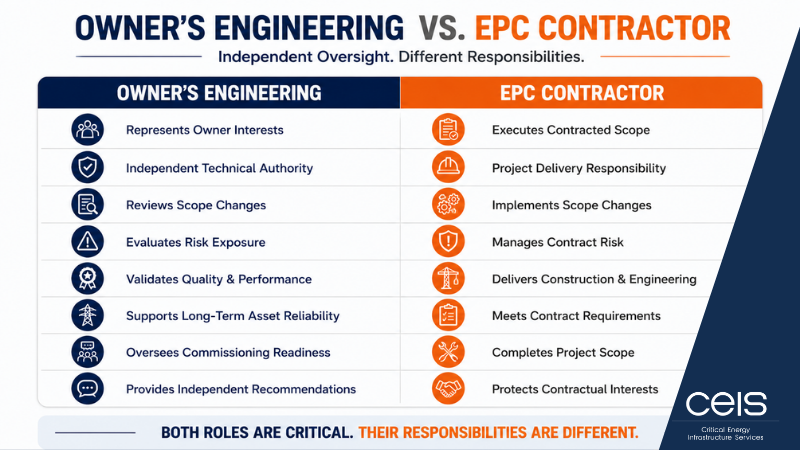
One of the most common misconceptions in infrastructure delivery is assuming an EPC contractor can also function as the owner's advocate.
While EPC firms provide significant value and are critical to successful project delivery, their role differs fundamentally from that of an owner's engineer.
This distinction becomes increasingly important as projects become larger, schedules become more compressed, and capital investments become more significant.
An experienced EPC contractor is essential to successful execution. An independent owner's engineer is equally important because they provide the owner with objective technical leadership and accountability throughout the project lifecycle.
Industry Pressure
Historically, many utilities and infrastructure owners maintained large internal teams capable of providing owner-side technical oversight. That model is becoming increasingly difficult to sustain.
01
Utilities are committing hundreds of billions of dollars toward transmission expansion, generation upgrades, substation modernization, reliability improvements, and grid resiliency programs.
02
Experienced project managers, construction managers, owner’s representatives, commissioning specialists, and senior engineers are retiring faster than many organizations can replace them.
03
Infrastructure projects increasingly involve multiple contractors, vendors, regulators, utilities, stakeholders, and technologies that must be coordinated simultaneously.
04
Organizations face growing pressure to deliver projects faster while maintaining expectations for safety, quality, reliability, and budget performance.
These trends have increased the value of independent technical leadership and execution oversight. As project complexity rises, the cost of poor decisions rises with it.
Planning-stage mistakes are often the most expensive. They may remain hidden until construction or commissioning. By the time those issues become visible, corrective action is significantly more expensive and disruptive.
Project Lifecycle Value
While owner’s engineering provides value throughout the project lifecycle, its impact is often greatest during three critical phases.
Owner’s Engineering helps infrastructure owners protect decisions before they become field commitments, maintain accountability during construction, and verify readiness before assets enter service.
The most consequential project decisions are often made before construction begins.
Equipment selections, procurement strategies, execution approaches, constructability assumptions, and design decisions all influence future project performance. Decisions made during planning ultimately become commitments in the field.
An experienced owner’s engineer helps identify risks early, challenge assumptions, validate execution strategies, and ensure project planning aligns with long-term operational requirements.
The most expensive project problems are rarely discovered during construction. They are often created during planning and become visible only after significant capital has already been committed.
Construction introduces a different set of challenges.
Schedules tighten. Scope changes emerge. Resource constraints appear. Contractors face productivity pressures. Unexpected field conditions create new risks.
This is often the phase where projects begin drifting away from their original objectives.
Owner’s Engineering provides independent oversight to maintain accountability across safety, quality, schedule, cost, and execution performance. The objective is not to interfere with construction activities but to provide owners with visibility and confidence that risks are being managed before they become larger problems.
Commissioning is where design intent, construction quality, equipment performance, and operational readiness all converge.
This phase frequently exposes issues that originated much earlier in the project lifecycle. Design assumptions are tested. Equipment performance is verified. Systems are integrated. Operators assume responsibility for long-term asset performance.
The purpose of commissioning is not simply to achieve mechanical completion. Successful commissioning verifies that systems perform as intended, deficiencies are resolved, operators are prepared, and the asset can enter service safely and reliably.
An owner’s engineer helps ensure that process is executed thoroughly and that project objectives are achieved before turnover occurs.
Infrastructure Applications
As infrastructure programs continue to grow in scale and complexity, Owner’s Engineering is increasingly becoming a strategic necessity rather than an optional service.
Across transmission, substations, generation, interconnection, and grid modernization programs, Owner’s Engineering has become increasingly important.
These programs often involve significant capital commitments, multiple stakeholders, and complex execution requirements.
Independent technical oversight helps utilities maintain visibility, improve decision-making, reduce risk, and strengthen execution performance throughout the project lifecycle.
The rapid growth of AI and hyperscale computing is creating a new category of infrastructure challenge.
Modern data centers require enormous amounts of reliable power. Developers, utilities, and infrastructure owners are racing to deliver generation, transmission, substations, interconnections, and supporting infrastructure quickly enough to meet demand.
The challenge is no longer identifying opportunities. The challenge is executing projects successfully.
Project Example
A strong example of owner-side execution support can be seen at NV Energy’s Silverhawk Generating Station.
As part of a 400 MW gas-fired modernization program, CEIS served as the Owner’s Representative across project management, construction management, and commissioning support.
The project required coordination across contractors, engineering teams, vendors, operational stakeholders, and commissioning personnel while maintaining strict performance expectations.
Execution Advantage
The infrastructure industry often focuses on engineering capability, equipment procurement, construction resources, and capital investment. All of those elements matter.
However, successful infrastructure delivery ultimately comes down to execution.
Execution determines whether schedules hold, budgets remain intact, risks are managed, and assets perform as intended.
Owner’s Engineering exists to strengthen execution through independent expertise, technical credibility, operational experience, and disciplined oversight.
As utilities, developers, and infrastructure owners navigate one of the largest infrastructure build cycles in modern history, organizations that prioritize owner-side execution support will be better positioned to deliver successful outcomes.
CEIS has provided Owner’s Engineering support across more than 100 power plant assessments and major infrastructure programs throughout North America.
CEIS Support
CEIS provides independent Owner’s Engineering, project management, construction oversight, commissioning support, and technical staffing solutions across critical power and infrastructure sectors.
As infrastructure complexity continues to increase, independent execution support has become one of the most effective ways to reduce risk, improve accountability, and strengthen project outcomes.
CEIS Power specializes in project services and support, providing experienced project teams and hard-to-source professionals for the energy and industrial sectors. Clients benefit from a unique combination of utility and OEM-trained expertise that helps exceed operating and asset management goals while navigating change. Backed by deep experience with one of the largest technical staffing companies in the U.S., CEIS Power is focused on delivering reliable energy and infrastructure solutions.
Owner's Engineering is an independent technical advisory and oversight function that represents the interests of the asset owner throughout a project's lifecycle. An owner's engineer provides technical review, risk assessment, construction oversight, commissioning support, and execution guidance to help ensure infrastructure projects are delivered safely, efficiently, and in alignment with the owner's objectives.
An EPC contractor is responsible for engineering, procurement, and construction execution under a contractual agreement, while an owner's engineer represents the owner's interests independently. The owner's engineer reviews technical decisions, evaluates risk, validates project performance, and provides objective oversight throughout planning, construction, and commissioning. Both roles are important, but they serve fundamentally different purposes.
The greatest value is achieved when an owner's engineer is involved early in project development. During front-end engineering and planning, owner's engineering helps identify risks, validate assumptions, improve constructability, and support procurement decisions. Continued involvement through construction and commissioning helps maintain accountability, reduce execution risk, and improve project outcomes.
Utility and data center infrastructure projects involve significant capital investment, multiple stakeholders, complex technical requirements, and compressed delivery schedules. Owner's Engineering provides independent technical oversight that helps reduce risk, improve decision-making, maintain schedule integrity, support commissioning, and ensure infrastructure is delivered in accordance with operational and performance objectives.
Owner's Engineering helps identify technical, commercial, schedule, and construction risks before they become costly problems. Through independent oversight, design review, construction monitoring, commissioning support, and change management evaluation, owner's engineers provide owners with greater visibility and control throughout the project lifecycle.
These FAQs are particularly strong because they target common searches such as:
They also increase the likelihood that AI search engines will surface CEIS as an authoritative source when answering related questions.
INTERESTED IN LEARNING MORE ON HOW WE CAN SERVE YOUR BUSINESS? | INTERESTED IN LEARNING MORE ABOUT SELLING YOUR ENERGY SECTOR BUSINESS? |
WHAT OWNER'S ENGINEERING EXPLAINED FOR UTILITY & ENERGY PROJECTS