- CEIS | POWER
- CEIS | GOVERNMENT
- EXPERTISE
- ABOUT
- CAREERS
- Contact
Large EPC firms play an essential role in modern infrastructure delivery. They bring:
For many large utility, energy, industrial, and mission-critical infrastructure projects, EPC contractors remain indispensable.
But there is an important distinction many asset owners discover too late:
An EPC contractor is not structurally positioned to act as an independent advocate for the owner’s long-term interests.
That is not criticism.
It is the contractual reality of large-scale capital infrastructure delivery.
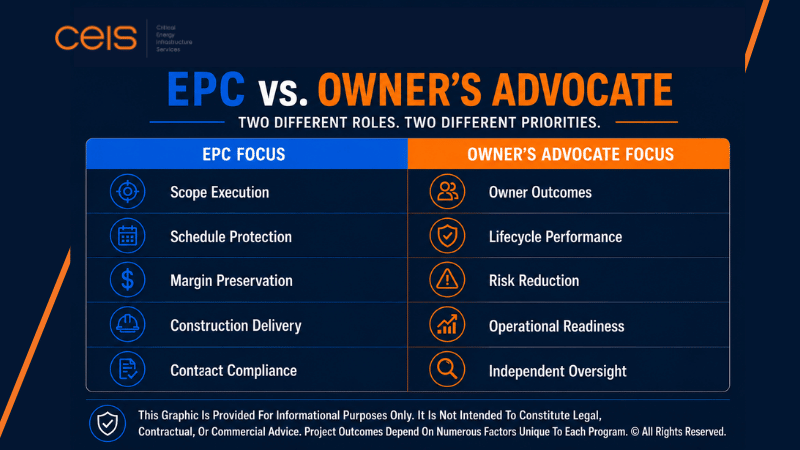
An EPC contractor’s commercial model is fundamentally tied to:
Those priorities are rational and expected within EPC delivery structures.
But they are not always perfectly aligned with the owner’s broader operational and strategic objectives.
Infrastructure owners are often optimizing for:
These objectives extend far beyond substantial completion.
As projects increase in scale and complexity, the gap between construction execution priorities and owner operational priorities becomes increasingly important.
In many large capital programs, the distinction between EPC execution and owner advocacy does not become visible during early engineering phases.
It emerges later.
Often during:
By that point, the owner is frequently operating inside compressed schedules, escalating budgets, and mounting operational pressure.
The cost of independent oversight becomes far smaller than the cost of discovering its absence late in delivery.
Owner’s engineering introduces an independent technical layer into project delivery.
The role is not to obstruct contractors.
The role is to ensure the owner maintains informed technical control over the program throughout execution.
An experienced owner’s representative helps infrastructure organizations:
Most importantly, owner’s engineering helps preserve alignment between what is being built and what the asset owner ultimately needs the infrastructure to become operationally.
The complexity of modern infrastructure delivery has increased substantially over the last decade.
Today’s utility and industrial projects often involve:
In these environments, owners are frequently managing:
Without an independent technical advocate, owners can quickly lose visibility into cumulative execution risk across the broader program.
As infrastructure capital programs continue scaling across utilities, transmission, data centers, and energy systems, owner-side technical oversight is increasingly becoming a strategic discipline rather than an optional advisory layer.
This shift is occurring because the financial exposure associated with delivery failure has grown materially larger.
Schedule delays now carry:
At the same time, many owners are operating with leaner internal engineering organizations than in previous infrastructure cycles.
That combination is driving increased reliance on experienced external owner-side delivery expertise.
There is a common assumption in infrastructure delivery that larger EPC firms inherently reduce owner risk.
In some respects, they do.
Large EPC organizations often provide:
But scale also introduces complexity.
Larger EPC structures can create:
As programs grow, independent owner-side technical visibility often becomes more important — not less.
The issue is not whether the EPC is competent.
The issue is whether the owner retains enough independent technical authority to make informed decisions throughout the lifecycle of the project.
CEIS works exclusively in support of infrastructure owners.
We maintain:
Our role is not tied to construction revenue, equipment procurement, or contractor margin structures.
Our responsibility is to the owner’s program performance.
That independence allows CEIS to provide:
In large-scale infrastructure delivery, that distinction is not branding.
It is risk management.
Independent owner-side engineering and program oversight can be particularly valuable in:
As infrastructure delivery cycles accelerate, maintaining independent technical visibility becomes increasingly critical to protecting schedule certainty, operational readiness, and long-term asset performance.
Explore how CEIS Owner's Engineering Services support infrastructure owners throughout complex project delivery.
Learn more about CEIS Program Management Support for utility and large-scale infrastructure execution.
See how CEIS Construction Oversight Services help improve quality assurance, commissioning readiness, and field coordination.
Discover CEIS Transmission & Distribution Expertise supporting grid modernization and transmission expansion initiatives.
CEIS Power specializes in project services and support, providing experienced project teams and hard-to-source professionals for the energy and industrial sectors. Clients benefit from a unique combination of utility and OEM-trained expertise that helps exceed operating and asset management goals while navigating change. Backed by deep experience with one of the largest technical staffing companies in the U.S., CEIS Power is focused on delivering reliable energy and infrastructure solutions.
Owner’s engineers help owners maintain technical visibility, validate contractor decisions, reduce execution risk, protect operational interests, and improve project delivery outcomes.
No. Owner’s engineering complements EPC delivery by providing independent oversight and owner-side technical advocacy throughout engineering, construction, commissioning, and turnover.
Large infrastructure programs often involve multiple contractors, complex procurement structures, aggressive schedules, and significant financial exposure. Independent oversight helps owners identify risk early and maintain alignment between project execution and long-term operational requirements.
Transmission, substations, data centers, grid modernization, generation upgrades, interconnection projects, industrial infrastructure, and other complex capital programs often benefit from independent owner-side technical representation.
INTERESTED IN LEARNING MORE ON HOW WE CAN SERVE YOUR BUSINESS? | INTERESTED IN LEARNING MORE ABOUT SELLING YOUR ENERGY SECTOR BUSINESS? |
EPC vs Owner’s Advocate in Large Infrastructure Delivery | CEIS