- CEIS | POWER
- CEIS | GOVERNMENT
- EXPERTISE
- ABOUT
- CAREERS
- Contact
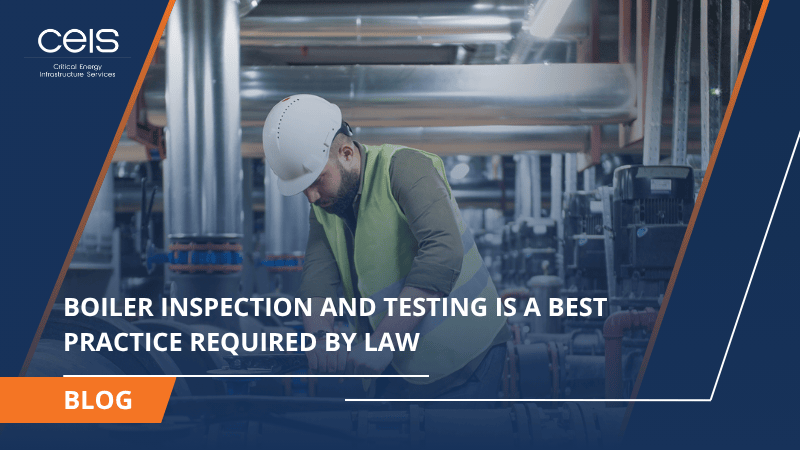
Regular boiler inspection and testing is not just a good practice—it is required by law.
Every U.S. state mandates at least one annual inspection of industrial and commercial boilers, carried out by certified inspectors from Authorized Inspection Agencies (AIA). These legal requirements underscore a simple truth: unsafe boilers are dangerous.
Boiler failures can halt plant operations, but far more critically, they can trigger catastrophic events resulting in major property damage and loss of life. Between the mid-1850s and the early 20th century, more than 50,000 people died annually from boiler explosions. While modern regulations and advanced safety equipment have significantly reduced such tragedies, incidents still occur each year.
The most effective way to mitigate these risks is through comprehensive inspection and testing.
Types of Inspections
Boiler inspections generally fall into two categories—internal and external—each playing a vital role in assessing equipment health.
These require accessing the inside of the boiler, pressure vessel, or tank to examine surfaces for corrosion, pitting, scale buildup, cracking, or other deterioration. Because these inspections require draining and opening the system, they can only be performed when equipment is offline.
External inspections evaluate the vessel's condition from the outside. Inspectors look for visible signs of wear, including leaks, damaged insulation, deformation, overheating, or vibration. Advanced techniques such as infrared thermography and ultrasonic testing help detect internal flaws without dismantling the system.
Key Testing Protocols
Beyond visual inspections, five essential types of testing should be included in a thorough boiler evaluation:
Comprehensive inspections often incorporate non-destructive testing (NDT) to assess the integrity of equipment without causing damage. The most common methods include:
Other NDT methods include Magnetic Particle Testing, Liquid Penetrant Testing, Hardness Testing, and Materials Testing.
Once all inspections and tests are complete, the boiler system is evaluated for fitness for service under ASME (American Society of Mechanical Engineers) guidelines.
The simplest answer: because the law requires it. But even without legal mandates, regular inspections are indispensable for ensuring plant safety, protecting workers, and preventing catastrophic failures.
There are additional benefits as well:
In short, inspection and testing are essential components of both safety and efficient plant management.
CEIS has a team of experts who understand the complexities of boiler maintenance, inspection, and renovation. We are leaders in energy and infrastructure services, providing integrated engineering, consulting solutions, and field services for turbines, boilers, and balance-of-plant systems.
CEIS Power specializes in project services and support, providing experienced project teams and hard-to-source professionals for the energy and industrial sectors. Clients benefit from a unique combination of utility and OEM-trained expertise that helps exceed operating and asset management goals while navigating change. Backed by deep experience with one of the largest technical staffing companies in the U.S., CEIS Power is focused on delivering reliable energy and infrastructure solutions.
INDUSTRIAL BOILER INSPECTION & TESTING | METHODS & SAFETY PROTOCOLS | CEIS